
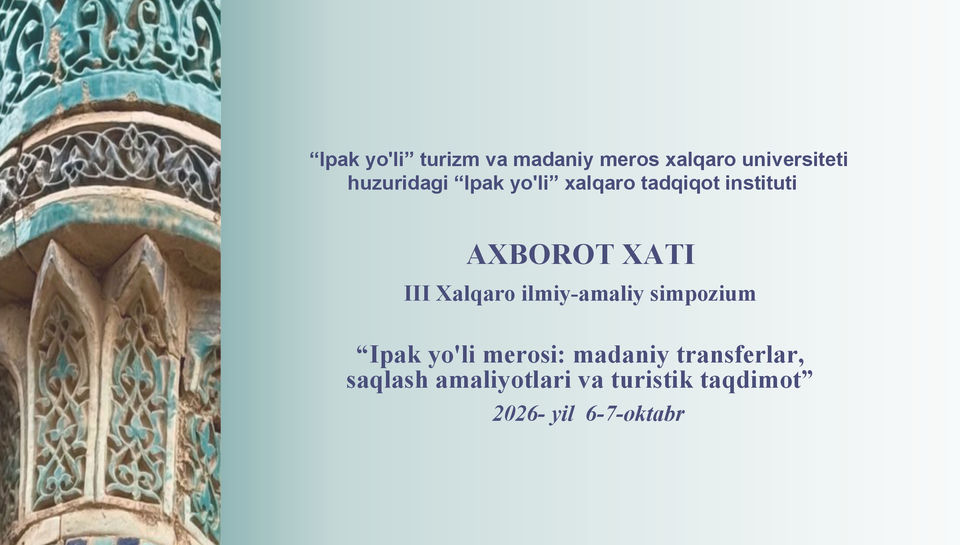
III International Scientific and Practical Symposium
“Silk Road Heritage: Cultural Transfers, Preservation Practices and Tourism Representation”
The “Silk Road” International Research Institute (IRI) at the “Silk Road” International University of Tourism and Cultural Heritage was established in accordance with the Resolution of the President of the Republic of Uzbekistan dated October 30, 2021, No. PQ-5270, “On measures to further improve the system of continuous training of qualified personnel in the fields of tourism, cultural heritage, and museology.”In the autumn of 2024 and 2025, the Institute held its first two annual international symposiums, which brought together approximately 170 scholars and specialists, including representatives from 19–20 foreign countries.
On October 6–7, 2026, the “Silk Road” IRI will hold in Samarkand the III International Scientific and Practical Symposium “Silk Road Heritage: Cultural Transfers, Preservation Practices, and Tourism Representation,” which has now become a regular event.
For many centuries, the Silk Road served as a key space of interaction among the civilizations of Eurasia. Through its network of trade and cultural routes, there was an intensive exchange of artistic ideas, technologies, materials, and aesthetic principles, which shaped a unique cultural environment connecting regions from East Asia to the Mediterranean. Under these conditions, new forms of artistic synthesis emerged, reflecting the interaction of diverse cultural traditions and professional practices.
The symposium is devoted to the study of the artistic heritage of Silk Road countries as a complex system of cultural transfers, within which artistic traditions, technologies, and visual forms were formed and disseminated. Special attention will be given to architectural heritage as a key resource for tourism attractiveness and as a foundation for the development of cultural routes and sustainable tourism. The symposium will also focus on artistic schools formed under the patronage of major dynasties, as well as on folk art that developed in regions connected by Silk Road routes.
Within the framework of interdisciplinary dialogue, the symposium will address contemporary methods of research, restoration, and conservation of architectural and artistic monuments; issues of attribution and the study of artistic technologies; as well as questions of museum representation and the popularization of cultural heritage in the context of tourism routes.
The symposium is aimed at fostering interdisciplinary dialogue among specialists, including art historians, Orientalists, archaeologists, architects, restorers, tourism professionals, museum specialists, and researchers of production technologies. Its goal is to expand scholarly understanding of the artistic heritage of Silk Road countries as a significant phenomenon of cultural interaction and historical memory in Eurasia.
Thematic areas (proposed panels):
- The Silk Road as a space of artistic transfers: history, theory, methodology.
- Architectural heritage and its significance for the development of cultural and pilgrimage tourism.
- Court culture and folk decorative and applied arts: the role of patronage in the formation of artistic schools; folk art as collective experience.
- Conservation and restoration of monuments: interdisciplinary research methods and contemporary restoration practices.
- Digital technologies, museum representation, and the tourism potential of heritage: 3D documentation, digital archives, virtual reconstruction, digitalization of museum activities, and cultural routes.
Art historians and historians of architecture, archaeologists, orientalists, restorers, materials scientists, museum curators, and tourism specialists are invited to participate. Source-based and archival research, technological analysis of artworks, as well as theoretical and methodological studies are particularly welcome.
Working languages of the symposium: Uzbek, English, and Russian.
Abstracts are accepted in these languages. The organizing committee reserves the right to select materials for publication following the symposium.
Format: onsite and online.
Travel expenses are to be covered by the sending party.
Accommodation (two nights, October 6–7), meals, participation in cultural events (excursions, exhibitions), and entrance tickets to architectural monuments will be covered by the “Silk Road” International Research Institute.
Venue address:
Republic of Uzbekistan, Samarkand, 17 University Boulevard
Building of the “Silk Road” International University of Tourism and Cultural Heritage
Abstract submission guidelines:
Texts should be submitted in Word 97–2003 or RTF format, in Times New Roman, 12 pt font, 1.5-line spacing, with standard margins (3 cm left, 1.5 cm right, 2 cm top and bottom). Abstracts must be submitted as separate files in three languages — Uzbek, English, and Russian. Each abstract should be 300 words in length, including keywords and author information. The author’s surname must also appear in the file name of both the application form and the abstract.
The title of the paper should be centered and written in uppercase bold letters on the first line. After one line, the author’s name(s) should be given in bold lowercase letters. The next line should include affiliation, position, academic degree and title (country), and email address.
After one line, the abstract text should follow. After the text, seven to eight keywords should be listed.
Abstracts in all three languages should follow the same formatting rules. The application form must indicate the author’s working language.
Presentations should be based on the authors’ original research, analysis, and conclusions. Practical recommendations should comply with technical and stylistic requirements. The Academic Council of the Organizing Committee reserves the right to select topics and participants. Authors bear full responsibility for the content of their presentations.
Submission deadline: july 20, 2026
Applications (author form) and abstracts should be submitted via the following link:
https://docs.google.com/forms/d/e/1FAIpQLSfeX7lMUFkl7kNH-HVYFJTP9FUIJNJeJptibJC3TBmlBL0fIw/viewform?usp=publish-editor
For inquiries, please contact:
Contact persons: Viktoriya Anshakova, Shirina Akhunova, Malika Akromova
Phone, Telegram, WhatsApp:
+998 99 823 56 74 Viktoriya
+998 99 804 04 36 Shirina
+998 94 516 33 99 Malika
Sample abstract format:
THE ROLE OF INNOVATIVE TECHNOLOGIES IN THE STUDY
AND RESTORATION OF CULTURAL HERITAGE OBJECTS
ABDULLA ABDULLAEV
Samarkand State University
Associate Professor, PhD in Architecture (Uzbekistan)
abdullaev@gmail.com
Keywords: 7–8 words separated by commas
Text text text (no more than 300 words)
The same format should be followed in Russian and Uzbek.
Related news
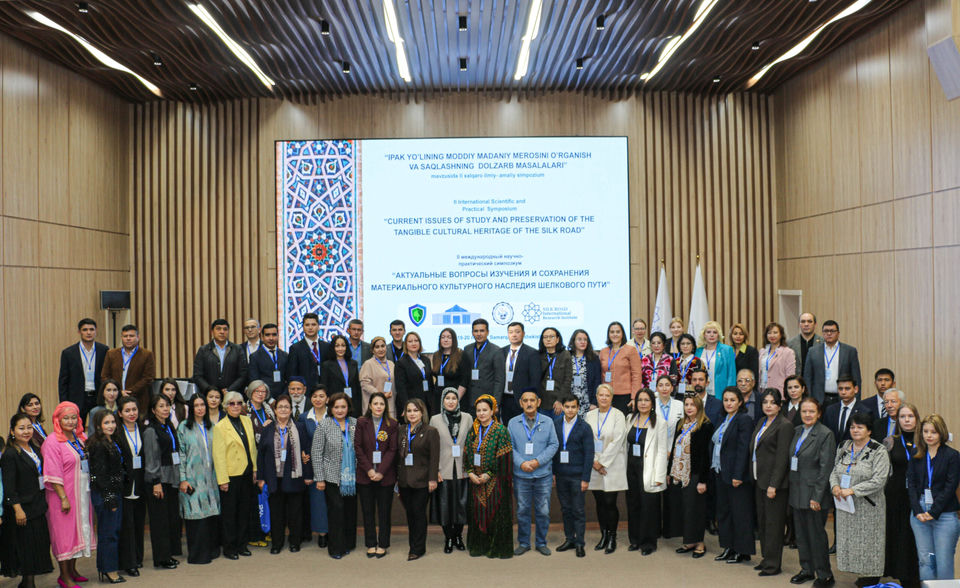
2nd International Scientific and Practical Symposium on Current Issues in the Study and Preservation of the Tangible Cultural Heritage of the Silk Road
The Silk Road International Research Institute under the Silk Road International University of Tourism and Cultural Heritage is holding the 2nd International Scientific and Practical Symposium “Current Issues in the…
INFORMATION LETTER
INFORMATION LETTER of Second International Scientific and Practical Symposium “ CURRENT ISSUES OF STUDY AND PRESERVATION OF THE TANGIBLE CULTURAL HERITAGE OF THE SILK ROAD " The “Silk Road” International Research…
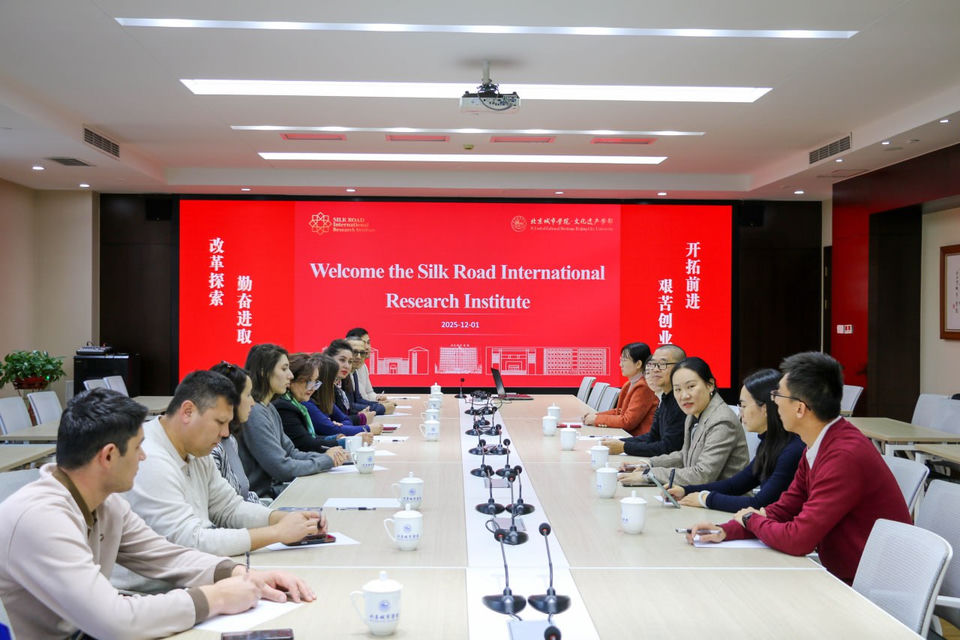
Visit of the Delegation of the “Silk Road” International Research Institute to a Number of Scientific and Cultural Institutions in Beijing
From November 28 to December 2, 2025, the staff of the “Silk Road” International Research Institute at the “Silk Road” International University of Tourism and Cultural Heritage, headed by the Director of the Institute…